A new metal carport or storage building doesn’t automatically raise your homeowners insurance premium — but it does change what your policy covers, and skipping that conversation with your insurer is the mistake that costs people money later.
Most homeowners assume their existing policy just stretches to cover whatever they add to the property. It doesn’t work that way. Detached structures fall under a specific, limited portion of your policy, and that limit doesn’t grow automatically just because you built something new. Understanding how that coverage works before you build means you’re not finding out the hard way after a storm.
Where a Detached Metal Building Fits in Your Policy
Homeowners policies split property coverage into separate buckets, and a detached custom-built carport or building falls under what’s formally called Coverage B, or “Other Structures.” According to the California Department of Insurance, this coverage protects other structures on the residence premises that are not attached to the dwelling, including detached garages and tool sheds, and is normally limited to 10% of the Coverage A (dwelling) limit. In practice, that means if your home is insured for $400,000, roughly $40,000 is automatically available for everything detached on your property combined — not just your new carport, but every shed, fence, and outbuilding you already have.
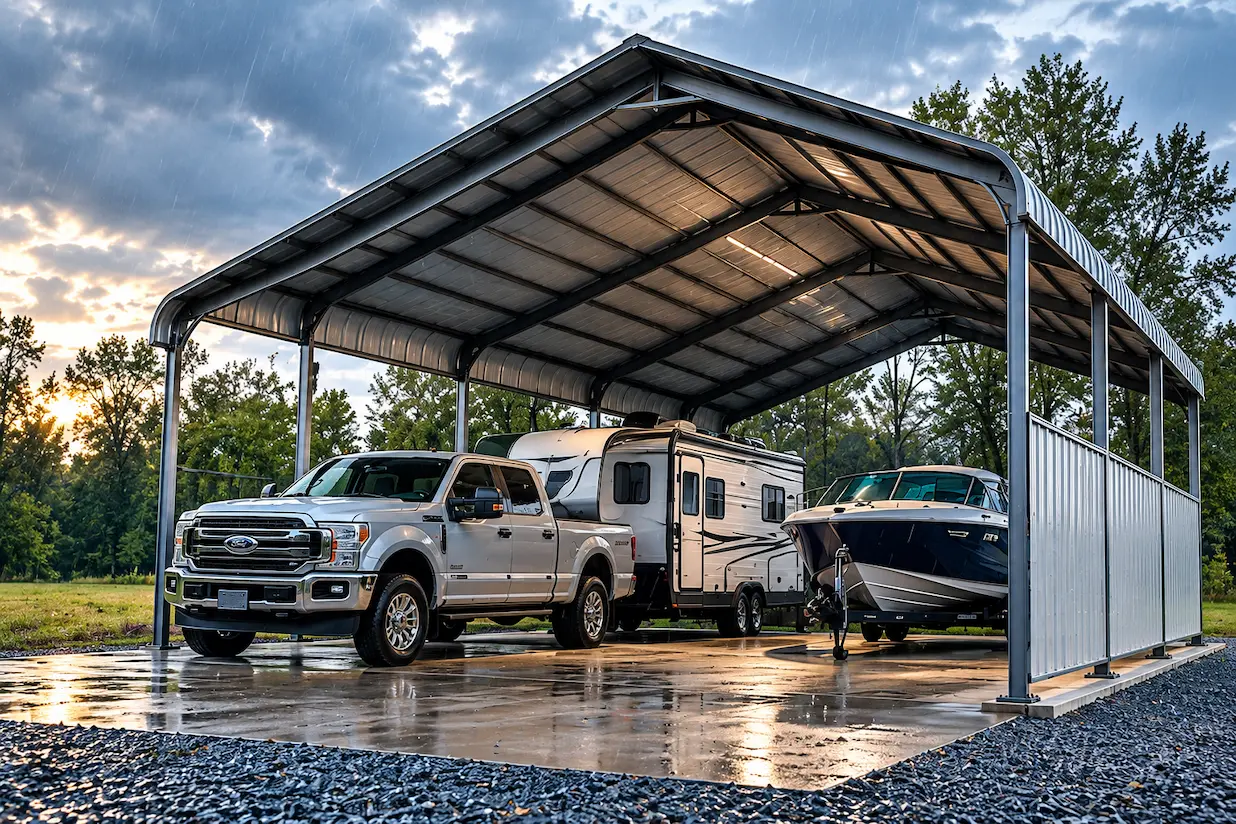
That 10% ceiling is the detail most people miss. If you’re building a larger steel structure — say, a workshop or a building sized for RV storage — its replacement cost can exceed that limit fast, especially stacked against whatever else is already sitting in that bucket. The California Department of Insurance notes you may purchase additional Coverage B for an added premium, which is the fix, but it only happens if you or your agent catch the gap before a claim, not after one.
What’s Actually Covered — and What Isn’t
The perils covered under Other Structures coverage mirror what’s covered on your home itself. Per the Department of Insurance’s guide, a standard policy typically covers fire or lightning, windstorm or hail, explosion, vandalism and malicious mischief, theft, weight of ice and snow, and falling objects, among others. That’s good news for a steel building specifically, since metal framing and panels rated for our snow and wind load guidance hold up well against most of those named perils compared to wood-frame alternatives.
What isn’t covered matters just as much. The same guide lists flood, earthquake, earth movement, and wear and tear as perils generally excluded from a standard policy. For anyone in a flood-prone or fault-adjacent part of California, that’s worth flagging directly with your agent — a metal building sited on a slab in a floodplain won’t be covered for flood damage unless you carry a separate flood policy through the National Flood Insurance Program.
Permits, Disclosure, and Why They Matter to Your Insurer
Building without a permit doesn’t just create a code problem — it can create an insurance problem. Insurers generally underwrite based on what’s disclosed and permitted on a property, and an unpermitted structure can complicate a claim if damage occurs, since the insurer may question whether the structure met the code requirements it should have. We cover the permit side of this in detail in Do I Need a Permit for a Metal Carport in California? and Metal Carport Permits in California — the short version is that most California jurisdictions require one, and pulling it protects both your investment and your coverage.
The practical move is simple: call your insurance agent before construction starts, not after it finishes. Tell them the size, use, and estimated replacement cost of the structure you’re planning. That gives them the chance to check whether your existing Other Structures limit covers it or whether you need to bump it up — a conversation that costs you nothing and can save a five-figure gap if something goes wrong later.
Business Use Is a Separate Conversation
One more distinction worth knowing: if the structure will be used for anything business-related — a home-based contracting operation, vehicle storage for a side business, inventory for an online shop — that use can fall outside standard homeowners coverage entirely. Our guide on metal buildings for storage business investment covers what changes when a structure crosses from personal to business use, since it typically requires its own commercial policy or endorsement regardless of how the structure itself is built. If that applies to you, loop your agent in on the intended use, not just the structure’s dimensions.
Getting the insurance conversation right before you build means the structure protects your investment the way it’s supposed to. If financing is part of your plan too, our financing options guide covers that side of the budgeting conversation — and our team can walk through sizing and specs so your conversation with your agent is a quick one. Get a quote to start.