An open carport isn’t a stripped-down version of an enclosed one. For a lot of California properties, it’s actually the smarter buy.
That runs against the instinct that more walls automatically means more protection, and therefore more value. But an open metal carport and an enclosed one solve different problems, and picking the wrong one means paying for coverage you don’t need — or leaving your vehicles and equipment exposed to a peril you should have planned for. The right choice comes down to what you’re storing, where you’re storing it, and how much airflow and access matter to your daily routine.
This guide breaks down what actually separates the two styles, when each one makes sense, and how the cost difference plays out over the life of the structure.
What Actually Separates an Open Carport From an Enclosed One
Both styles start from the same bones: a steel carport frame, a roof panel system, and a foundation anchored to concrete or ground anchors. The difference is what happens at the sides. An open carport leaves the sides free, using only roof and support posts to shield whatever sits underneath. An enclosed carport adds wall panels, and often a roll-up or walk-in door, turning that same footprint into a lockable space.
That single change affects more than security. Enclosed structures trap heat and reduce airflow, which matters if you’re storing anything sensitive to condensation, like tools or upholstered equipment. They also cost more per square foot, since you’re paying for wall panels, additional framing, and typically a door package on top of the base structure. Neither style is structurally “better” — a well-built open carport handles the same wind and snow loads as an enclosed one when it’s engineered to the same specifications.
When an Open Metal Carport Makes Sense
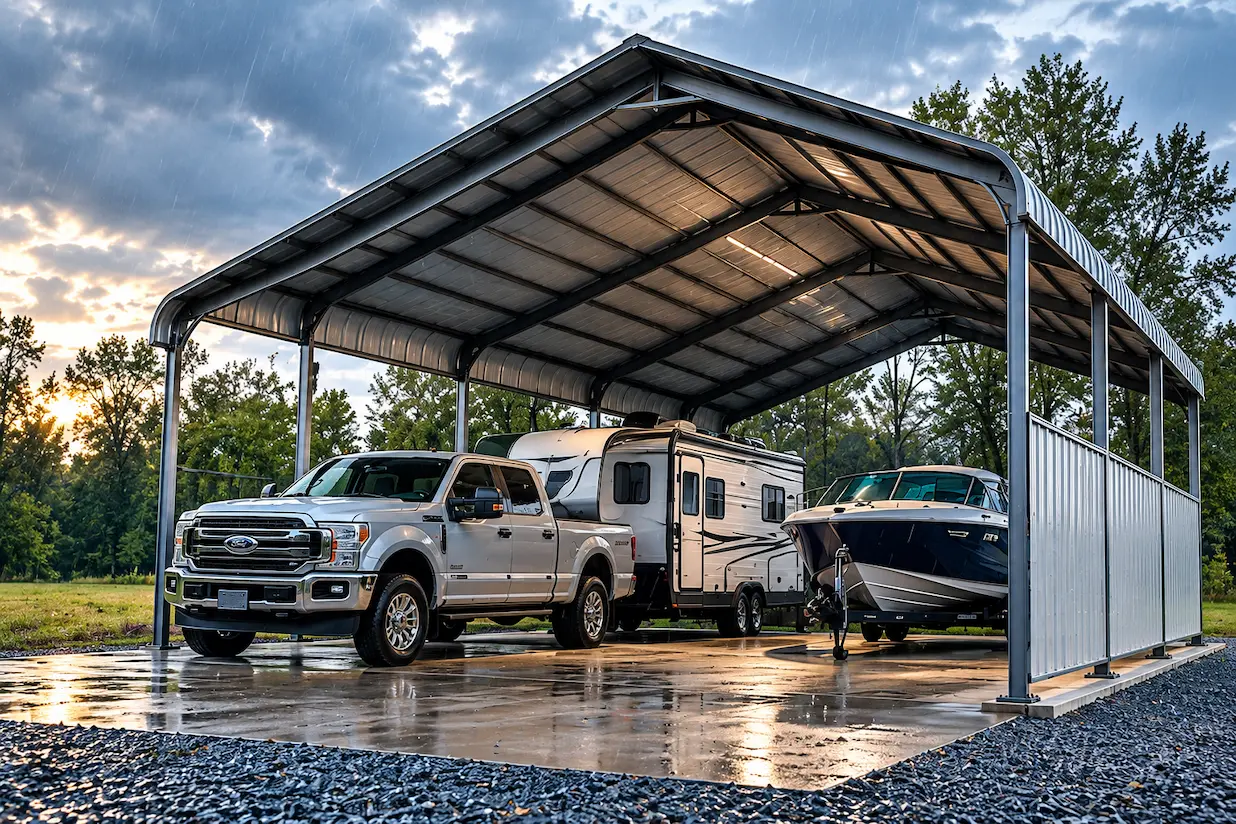
Open carports earn their keep in a few specific situations. If you’re parking daily-driver vehicles, farm equipment, or an RV you use often, the open-air design means you’re not fighting a door every time you need access. Airflow also matters more than people expect in California’s Central Valley heat — an enclosed space with limited ventilation can trap warm air and accelerate wear on tires, seals, and upholstery just as much as direct sun exposure does.
Cost is the other driver. An open structure gets you covered parking at a lower price point than an enclosed one of the same footprint, which makes it the practical choice when the goal is basic protection from sun, rain, and hail rather than security or long-term storage. If you’re weighing a custom layout — wider spans, taller clearance for an RV, or a combination with attached storage — a custom metal carport build lets you dial in the open-air footprint to the vehicle or equipment you actually own.
When to Choose an Enclosed Metal Carport
Enclosed carports make sense the moment security, long-term storage, or full weather protection becomes the priority. A lockable metal garage-style structure protects against theft and vandalism in a way an open one never will, which matters for tools, ATVs, or a second vehicle you’re not using every day. It also blocks wind-driven rain and dust, which an open roof alone can’t fully stop.
UV exposure is worth factoring in too. Ultraviolet radiation reaching the ground varies by season, cloud cover, and location, and the U.S. EPA tracks that intensity through its daily UV Index specifically because the index predicts solar UV radiation levels and indicates the risk of overexposure on a scale from 1 to 11 or more. A vehicle or piece of equipment parked under an open roof still takes reflected and ambient UV exposure on its sides, which over years contributes to paint fading and material breakdown. An enclosed structure with walls removes that exposure almost entirely, which is part of why many owners upgrade from open to enclosed specifically to protect a classic car, boat, or high-value tool collection. If you’re deciding between a fully enclosed build and something in between, our metal carport vs. metal garage comparison walks through the next tier up in enclosure and cost.
Cost and Long-Term Value Comparison
The upfront price gap between open and enclosed is real, but it’s not the only number worth tracking. An enclosed structure costs more to build, but it can reduce long-term maintenance on whatever’s stored inside — less UV fading, less debris accumulation, and no exposure to wind-driven rain during storms. An open structure costs less upfront and less to maintain as a structure, since there are no doors or wall panels to service, but it shifts more of the protection burden onto whatever’s parked underneath.
For most California properties, the deciding factor isn’t climate — it’s use case. Daily-use vehicles and equipment that come and go do better under an open roof. Anything parked for weeks or months at a time, or anything valuable enough to worry about theft, justifies the enclosed build. Our guide on carport vs. garage costs breaks down the next level of that spending curve if a fully enclosed garage ends up being the better fit.
Whichever direction fits your property, the framing and foundation work is the same either way — the walls are where the decision actually shows up in your budget. If you’re still weighing the two, request a quote and we’ll help you size the right structure for what you’re protecting.