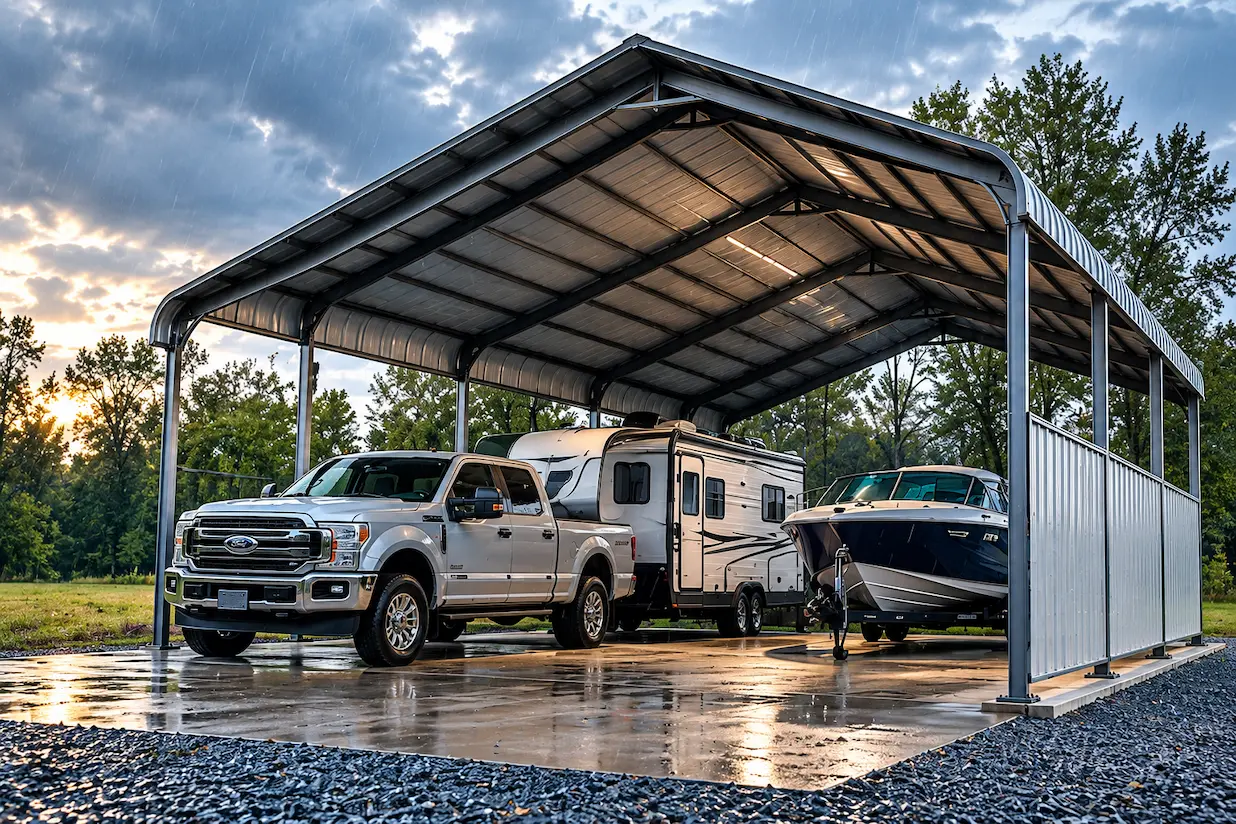
A boat left uncovered doesn’t fail all at once — it degrades a little every season, in the gelcoat, the upholstery, and the trailer it sits on, until a few years in you’re facing repairs that a properly sized custom carport would have prevented outright. Owners who store their boat under a metal carport instead of leaving it exposed usually make that call after the first repair bill, not before.
Sizing that structure correctly is the part most people get wrong on the first try. Get the dimensions right and the carport protects the investment for decades. Get them wrong and you’re either cramming a boat into a space that doesn’t give you room to work, or paying for square footage you didn’t need.
Measuring What You’re Actually Storing
Boat storage sizing starts with three numbers: length, beam (width), and height with the boat on its trailer. Length is straightforward — measure bow to stern, then add trailer tongue length if you want the whole rig to fit without the tongue hanging past the roofline. Beam matters more than people expect, since many boats are wider than they look from the water, and you’ll want clearance on both sides for walking around the boat during maintenance, not just enough width to squeeze it in. Our general guide on how wide a carport needs to be covers the clearance math in more detail if you want to work through it side by side.
Height is the number that gets underestimated most often. Measure from the ground to the highest point of the boat while it’s sitting on the trailer — that’s usually the top of a wakeboard tower, hardtop, or windshield, not the hull itself. Add clearance above that for the trailer jack when raised and for comfortable walk-around access, since a roofline that just barely clears your boat today won’t accommodate a taller replacement down the road.
Why Clear Span Matters for Boat Storage
Support posts placed at the wrong intervals can turn a technically-large-enough carport into a frustrating fit. A clear span metal building removes interior support posts entirely, which matters more for boat storage than almost any other use case — you need the full width and length open to maneuver a boat and trailer in and out without threading between posts, especially if you’re backing in solo.
If your storage needs go beyond just the boat — trailer, water sports gear, a dock box, winter covers — pairing the carport with attached storage is worth planning for upfront rather than adding later. Our carport and shed combo guide covers how that layout works in practice.
Open vs. Enclosed for Boat Storage Specifically
The open-vs-enclosed decision plays out a little differently for boats than for vehicles. An open carport handles the core job — blocking direct sun and rain, which are the two biggest threats to gelcoat and upholstery — at a lower cost than an enclosed structure. For boats used regularly through the season, that open access also means backing in and out doesn’t require managing a door every trip.
An enclosed structure makes more sense for boats stored long-term, especially over an off-season, or for higher-value boats where theft risk and full weather sealing matter more than daily access convenience. If you’re weighing that trade-off in more depth, our enclosed vs. open metal carports guide covers the decision framework in full, most of which applies directly to boat storage.
Planning for Trailer Tongue and Backing Clearance
One sizing detail that trips up even experienced boat owners: the structure needs to accommodate the turning radius required to back the trailer in, not just the trailer’s parked footprint. If your driveway or side yard has a tight approach angle, building in a few extra feet of width at the entrance makes the difference between an easy daily-use structure and one you dread backing into. If you’re not sure how much clearance your specific approach needs, that’s a detail worth walking through with our team before finalizing dimensions — the same team that can help pair your boat storage with a shed combo if you need both under one roof.
Getting the Sizing Right the First Time
The cost difference between “right-sized” and “one size up for safety” is usually smaller than people assume, and it’s cheaper than resizing after the fact. Bring us your boat’s dimensions — length, beam, and trailer height — and we’ll help you land on a footprint that fits comfortably today and still works if you upgrade boats down the line. Get a quote to get started.